


- The Austrian IVF Fund covers 70% of the costs for up to four IVF or ICSI treatment cycles.
- The woman must be under 40 at the start of treatment, and her partner must be under 50.
- You need a recognized medical diagnosis and must undergo treatment at an approved fertility clinic.
- Billing is handled directly by the fertility clinic, which must be a contracted partner of the Austrian IVF Fund.
Are you currently on your journey to start a family and considering in vitro fertilization (IVF), but worried about the costs? You may be eligible for financial assistance from Austria’s IVF Fund. Find out here when you’re eligible for the IVF Fund and how you can increase your chances of a successful cycle.
Before we dive into the details of the IVF fund, here’s a brief overview of the IVF process for you:

What Is the IVF Fund?
The IVF Fund is a government-run fund that covers a large portion of the costs of assisted reproduction for couples struggling to conceive. It has been in existence since 2000 and is financed by the Family Burden Equalization Fund and health insurance providers. In 2024, the fund helped finance 12,623 treatment cycles for 7,531 couples. In Austria, the IVF Fund covers 70% of the costs for up to four IVF or ICSI attempts. The prerequisite is that the treatment takes place at a participating center. You do not need to submit an application, as a participating center bills the Fund directly.
New in 2026: In July 2026, the Austrian federal government announced plans to reduce the patient co-payment from 30% to 25%. It is not yet clear when this change will take effect. We will update this article as soon as the new regulation comes into force.
Who is eligible? An overview of the requirements

|
What? |
Requirement |
|
Age of the woman carrying the child |
Under 40 years of age at the start of the treatment cycle; an ongoing treatment cycle may still be completed |
|
Age of her partner |
Under 50 years of age |
|
Relationship status |
Marriage, registered partnership, or cohabiting partnership; since 2015, this also includes two women |
|
Residence |
At least one person must have their primary residence in Austria |
|
Insurance |
Both partners must have health insurance coverage (statutory or recognized private) |
|
Medical Diagnosis |
At least one of the recognized indications (see below) |
|
Treatment Location |
A center contracted with the IVF Fund |
Under the Reproductive Medicine Act, unmarried couples require notarized consent for treatment; according to clinics, the cost for this is approximately €100–300.
Which diagnoses are recognized?
The Fund will only cover costs if one of the following causes has been medically diagnosed by a specialist:
For women:
- Bilateral blocked or permanently non-functional fallopian tubes
- Endometriosis resulting in infertility (confirmed surgically or via imaging)
- Polyendocrine Metabolic Ovarian Syndrome (PMOS, formerly PCOS) confirmed by imaging and resulting in infertility
The diagnoses must be made by a gynecologist.
For men:
- A severe, idiopathic impairment of sperm quality (documented by two semen analyses conducted at least four weeks apart)
- Sterility or severe infertility resulting from a diagnosed medical condition
The diagnosis may be made by a medical specialist (regardless of specialty).
Important: Male factor is the most common cause. In 2024, the cause was exclusively male in 58% of the couples receiving financial assistance, in both partners in 29%, and exclusively female in only 13%. “Unexplained” infertility without these diagnoses is not covered.
What does the fund cover and what does it not cover?
The fund covers 70% of the established rate for IVF, ICSI, and cryotransfers (transfer of frozen embryos), as well as testicular sperm extraction (MESA/TESE) if necessary. The rate includes consultations, ultrasounds, laboratory services, psychological counseling, stimulation medications, and the freezing and storage of embryos for up to 12 months.
The following are not covered:
- Intrauterine insemination (IUI)
- Costs for sperm or egg donation
- Additional services provided by the clinic, e.g., time-lapse incubation, IMSI, assisted hatching, or preimplantation genetic testing
- Treatments following a voluntary sterilization
- Attempts that are paid for privately and submitted for reimbursement only afterward—reimbursement is not possible
What you pay out of pocket: With IVF Fund support, your co-payment is typically around €1,100 to €1,500 per IVF or ICSI cycle, while a frozen embryo transfer costs approximately €300 to €600. Without IVF Fund support, costs range from around €6,000 to €7,000 per cycle, including medication. You can find a detailed breakdown of prices, additional costs, and a sample calculation in our article IVF Costs in Austria.
How many attempts are covered?
The fund covers up to four attempts. An “attempt” is defined as a complete treatment cycle up to the pregnancy test—including a cycle that was discontinued. Each subsequent transfer of frozen embryos counts as a separate attempt. The only exception is a termination for medical reasons following egg retrieval if the frozen embryos are used in the next cycle—in this case, the terminated cycle from which the eggs originated and the cycle in which they are transferred are considered a single attempt. If the treatment results in a pregnancy, a new entitlement to four attempts arises, for example, for a second child. On average, women needed about 1.7 attempts in 2024.
Process: How to Qualify for Financial Assistance
- Diagnosis: A gynecologist or urologist determines the cause (e.g., semen analysis, fallopian tube patency).
- Choose a participating center: Financial assistance is available only at these centers. An up-to-date list of all centers is available on the Ministry of Family Affairs’ website.
- Evaluation at the center: The center verifies the diagnosis, age, insurance, and place of residence.
- Treatment contract and copayment: You pay your share directly to the center; the center settles the remainder with the fund.
- Report the result: No later than three months after the attempt, you must notify the center using a form to indicate whether a pregnancy has occurred. If you fail to report the result, the fund may reclaim the money.
What are the chances?

According to the 2024 IVF Registry, about one in three embryo transfers resulted in a pregnancy (34%). For women between the ages of 36 and 40, the rate was 29%; for younger women, it was 37–38%. Your individual chances depend heavily on your age and the underlying cause—it’s best to discuss this during your initial consultation. About one-quarter of the attempts resulted in a birth.
How to Prepare for IVF
Eggs and sperm take about three months to mature. So what you do today affects the quality of the cells that will be retrieved during treatment three months from now. It’s therefore worth starting your preparation as soon as you’ve decided to undergo IVF, not just when stimulation begins.
Since male factors contribute to infertility in more than half of couples, it’s worth preparing for fertility treatment together. Find out how you can support your fertility in our guides Pimp my Eggs and Pimp my Sperm.
Medical Preparation
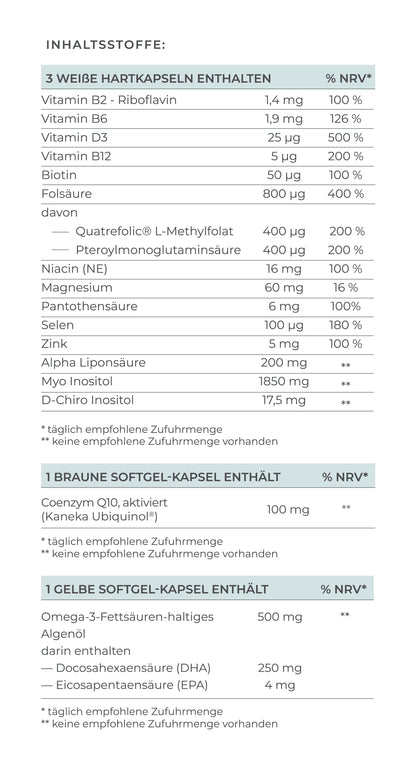
- Micronutrient supply and folic acid: Professional organizations recommend that women planning to become pregnant take 400 µg of folic acid daily, ideally starting at least four weeks before conception. Read more in the article “Important Nutrients for Fertility.”
- Check vaccination status: Immunity to rubella and chickenpox should be established before pregnancy. If you are not immune, vaccination before treatment is advisable.
- Have blood tests done: Among other things, thyroid levels and vitamin D levels are often assessed. To learn why vitamin D plays a role when trying to conceive, see “Vitamin D and Trying to Conceive.”
- Discuss pre-existing conditions and medications: such as PCOS (now also called PMOS), endometriosis, or a chronic illness.
- Semen analysis: A recent semen analysis is part of every evaluation—in more than half of the couples receiving fertility treatment, the cause lies (in part) with the man.
Lifestyle: What Really Matters
- Quit smoking: Smoking is one of the best-documented risk factors for poor egg and sperm quality.
- Cut back on alcohol: Studies link even moderate alcohol consumption to lower success rates with IVF/ICSI—in both women and men. Read more in the article “Improving Egg Quality.”
- Keep an eye on your weight: Being significantly overweight or underweight can affect hormone balance and treatment success.
- Eat a balanced diet: Lots of vegetables, fruits, whole grains, legumes, and healthy fats; limit highly processed foods. You can find tips on this in “Nutrition and Trying to Conceive” and in “How Highly Processed Foods Affect Fertility.”
- Get enough sleep: Studies suggest that women who sleep less than seven hours a night have fewer mature eggs during IVF.
- Avoid hormone-disrupting substances: These include, for example, plasticizers found in plastic, which we’ve described for you in the article “How Microplastics Threaten Fertility.”
Organizational and Emotional Considerations
- Schedule appointments: During ovarian stimulation, several ultrasound appointments are often necessary within a few days, usually early in the morning. On the day of egg retrieval, you won’t be able to work due to the anesthesia. So be sure to take this into account when scheduling your appointments.
- Complete the notarial deed in a timely manner: The notarial deed must be completed if you are not married but wish to receive support from the IVF Fund.
- Accept support: Psychological counseling is included in the Fund’s coverage—be sure to actively ask about it at your center. For many couples, IVF is more emotionally taxing than expected.
- Preparing for the initial consultation: Be prepared for the initial consultation by asking all the questions that are important to you to find out whether the clinic and the proposed treatment methods are a good fit for you. Since we know how stressful these initial consultations can be, we’ve put together a checklist for you. You can download the checklist here for free or, if you prefer, use this ink-saving version.
Frequently Asked Questions About the IVF Fund
Do I need to submit an application to the IVF Fund?
No, your contracted center will handle that. There, they’ll verify your diagnosis, age, insurance, and place of residence; you’ll sign a treatment agreement; and you’ll pay the copay to the center. The center will settle the remainder with the fund. Your only obligation afterward: to report whether you have become pregnant no later than three months after the procedure.
Does the IVF Fund provide coverage even after a woman turns 40?
No, the woman who wishes to carry the child to term must be under 40 years of age. However, the start of the treatment cycle is what matters: A cycle that begins before her 40th birthday is still eligible for funding and may be completed; any subsequent cycles are not. After that, treatment is possible as a self-pay patient. Because the success rate declines starting in one’s mid-30s, it’s worth not delaying an evaluation. Read more about this in “Getting Pregnant at 40” and “What a Low AMH Level Really Means.”
Do lesbian couples receive funding from the IVF Fund?
Yes, since 2015—but only if the woman who intends to carry the child has one of the recognized diagnoses (e.g., blocked fallopian tubes, endometriosis, or PMOS). The fund does not cover the cost of donor sperm. Without a diagnosis, IVF treatment is possible but must be paid for privately.
Does the IVF Fund cover insemination?
No, the fund only covers IVF, ICSI, and cryotransfers. Insemination (IUI) is often the first step for milder cases and usually costs a few hundred euros per cycle out-of-pocket, but must be paid for privately.
Find out how much a frozen embryo transfer costs with and without IVF Fund support in our article: IVF Costs in Austria.
What happens to frozen embryos?
The freezing and storage of embryos for twelve months are included in the fund’s rate. After that, you pay for storage yourself (example: about €380 per year). Each transfer of a frozen embryo counts as a separate attempt but is significantly less expensive than a new cycle involving ovarian stimulation.
Does the fund cover the costs if only the man has a diagnosis?
Yes, a severe impairment of sperm quality, confirmed by two semen analyses, is sufficient grounds for coverage—even if the woman’s results are normal. In this situation, ICSI is usually performed. For more background, see “Low Sperm Count: Getting Pregnant Despite Oligozoospermia” and “TESE for Azoospermia.”
Is preimplantation genetic testing (PGT) covered?
No, PGT is permitted in Austria only in certain cases and is not covered by the IVF Fund. Learn more in “Preimplantation Genetic Diagnosis: Opportunities and Challenges.”
How many attempts are needed on average?
In 2024, the average was 1.7 attempts per woman. The number of eggs and embryo transfers required in each individual case is explained in “IVF Success Rates.”
References
- Sozialministerium: IVF-Fonds
- Liste der Vertragszentren des IVF-Fonds, Stand September 2026
- Broschüre „Wir möchten ein Baby“ (Sozialministerium)
- IVF-Register Jahresbericht 2024
- ORF: Fonds für künstliche Befruchtung wird ausgebaut (18. Juli 2026)
- Kinderwunsch-Clinic Dr. Zech: IVF-Kosten
- Kinderwunschklinik Wels: IVF-Fonds Österreich 2026
- Kinderwunschklinik Wels: Preise für Selbstzahler