


The most important information about EmbryoGlue® summarized
- EmbryoGlue® is intended to improve the likelihood of implantation and communication between the uterus and the embryo
- EmbryoGlue® is currently still considered controversial as there are not yet sufficient studies to clearly prove its benefits
- However, some patients, especially those with repeated implantation failure or those undergoing a cryocycle, may well benefit from EmbryoGlue®
- The only specific risk associated with the use of EmbryoGlue® that has been identified so far is an increase in multiple pregnancies
On your journey to parenthood, you will encounter numerous offers that are designed to help improve the chances of success with artificial insemination. Sooner or later, you will probably come across the term “EmbryoGlue®” – but what is really behind this supposed miracle cure and what does science have to say about it?
In this article, you will find an honest, scientifically sound, and up-to-date assessment to help you decide whether EmbryoGlue® could be worthwhile for you.
What exactly is EmbryoGlue®?
EmbryoGlue® is a transfer medium produced by the Swedish company VitroLife. This innovative transfer medium is designed to increase the likelihood of implantation and improve communication between the embryo and the uterus. The positive effects of EmbryoGlue® are primarily attributed to the added hyaluronic acid and nutrients that support the embryo.
Although EmbryoGlue® sounds promising, there are still doubts among experts as to whether and when the product could be useful or is useful (Bhoi, N. R., et al., 2024).
First of all, we must point out that some studies on this topic do not refer specifically to the EmbryoGlue® product, but to hyaluronic acid-enriched transfer media in general. We will point this out to you in the course of the article if we are not specifically referring to EmbryoGlue®.
EmbryoGlue® for transfer with “fresh” embryos
In a 2015 study involving 84 women, the embryo was treated with EmbryoGlue® in half of the women. Fresh, non-donated embryos were used in all participating women. No significant difference was found between the EmbryoGlue® group and the control group in terms of clinical pregnancy rate or implantation rate. However, the study clearly shows that EmbryoGlue® achieved a significant improvement in implantation in women who had already undergone failed IVF attempts: Successful implantation was observed in half of the women in the EmbryoGlue® group with previous failed IVF attempts, while in the control group, no woman with a previous failed attempt had a successful implantation (Singh, N., et al., 2015).
The results of a study conducted in 2006 point in a similar direction, with hardly any differences in the success rates of IVF cycles between the EmbryoGlue® group and the control group. However, it was shown that women with repeated implantation failure and patients with fallopian tube problems had a significantly increased implantation rate—although only patients with fallopian tube problems also had an increased clinical pregnancy rate. In addition, the study authors note that there were significantly more triplet pregnancies in the EmbryoGlue® group (Valojerdi, M. R., et al., 2006). Although this may sound positive to many at first glance, triplet pregnancies are high-risk pregnancies and should therefore not be underestimated.
Another study with fresh (non-donated) embryos involving over 200 patients from 2008 did not show any significant improvement in pregnancy rates or implantation rates (Hazlett, W.D., et al., 2008).
EmbryoGlue® for frozen embryo transfer (cryotransfer)
A study conducted in 2024, which examined a total of 1,298 cryotransfer cycles, offers hope for women between the ages of 20 and 40 who have had either their own or donated embryos transferred and do not have any uncontrolled diseases such as diabetes or an endometrial thickness of less than 7 mm: The scientists showed that women whose embryos were treated with EmbryoGlue® had an increased chance of clinical pregnancy (69.5% with EmbryoGlue® compared to 57.6% without EmbryoGlue®). In addition, the use of EmbryoGlue® significantly increased the live birth rate – from 47.5% without EmbryoGlue® to 60.6% with EmbryoGlue®. Unfortunately, this study did not show a reduction in miscarriages through the use of EmbryoGlue® (Bhoi, N.R., et al., 2024).
However, the results of a study conducted in 2021, in which neither the patients nor the treating physicians knew which individuals were in the control group and which had been treated with EmbryoGlue®, are sobering. Frozen embryos were also used in this study, but no women with repeated implantation failure (RIF; Repeated Implantation Failure). In this study, the scientists found that there was virtually no difference between treatment with or without EmbryoGlue® in terms of success rates. The clinical pregnancy rate, live birth rate, implantation rate, and miscarriage rate were almost exactly the same. The only significant difference that could be observed in this case was that the birth weight of children treated with EmbryoGlue® was significantly higher than that of the control group (Yung, S. S. F., et al., 2021).
What do these study results mean?
Unfortunately, the study results on EmbryoGlue® are currently inconclusive and do not allow for a definitive blanket recommendation. One of the largest analyses to date examines the effects of hyaluronic acid enrichment (NOTE: not EmbryoGlue® as a product!) based on the results of 6704 participants. The study authors also point to the rather poor study situation at the time of publication of the analysis (2020). However, based on this rather insufficient study data, the scientists nevertheless draw some conclusions: For every 14 embryo transfers with hyaluronic acid-enriched transfer medium, there is one additional live birth thanks to hyaluronic acid. The experts also suspect a higher clinical pregnancy rate and possibly a reduction in the miscarriage rate. Multiple pregnancies could also occur more frequently with the use of hyaluronic acid enrichment (Heymann, D., et al., 2020).
Based on this, among other things, the ESHRE Add-ons Working Group (a group of experts from the European Society of Human Reproduction and Embryology) recommends using hyaluronic acid in higher concentrations (as in EmbryoGlue®). However, it is strongly emphasized that only a single embryo should be transferred in order to reduce the risk of multiple pregnancies (ESHRE Add-ons working group, et al., 2023).
Is EmbryoGlue® right for me?
It is difficult to say definitively whether EmbryoGlue® is right for you. The decision must be made based on whether you have already undergone unsuccessful IVF attempts or are just starting out, and whether you are using frozen or fresh eggs.
As the study results are very inconclusive and also vary greatly, we have a few suggestions for you on what you could ask your treating physicians or clinic:
- Does your clinic have its own data on EmbryoGlue®?
- Are there any differences between EmbryoGlue® and your standard medium?
- For which patients do you specifically recommend EmbryoGlue® (based on your own experience)?
- Our personal view as a company on EmbryoGlue®
EmbryoGlue® could be a useful addition to the fertility journey for at least some patient groups—especially for patients who have already undergone failed IVF cycles. However, it is important to note that EmbryoGlue® unfortunately has no influence on the quality of the embryo itself, but “only” attempts to facilitate the embryo's attachment to the uterine lining and communication between the embryo and the uterus, as mentioned at the beginning. Unfortunately, even with EmbryoGlue®, a poor-quality embryo cannot lead to a (successful) pregnancy.
EmbryoGlue® can therefore be a building block, but it does not replace:
- Good embryo quality (and, of course, egg and sperm quality)
- A holistic and adequate supply of nutrients
- Hormonal balance
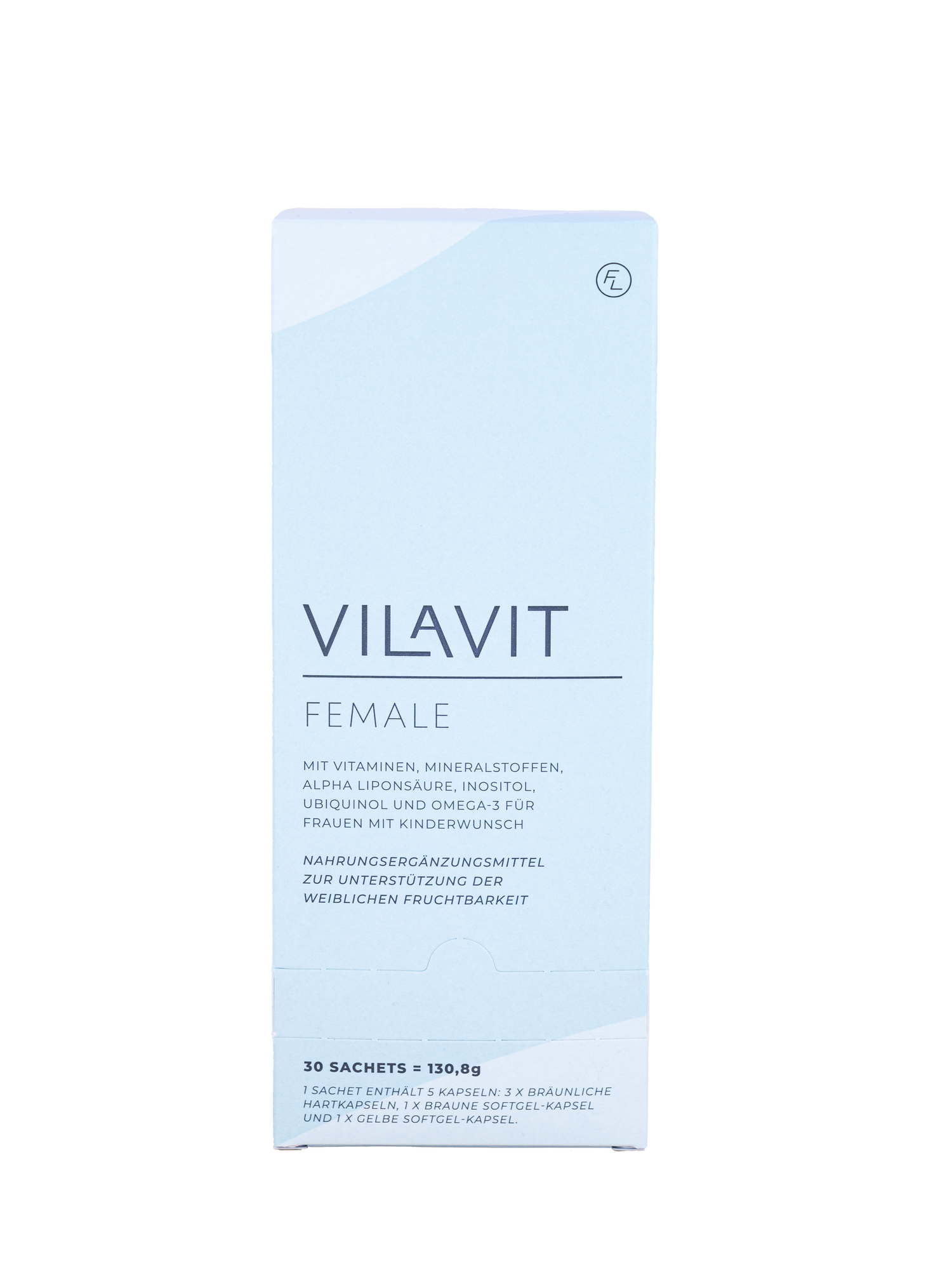
For this reason, we advise you to think holistically and not just about the implantation itself, because many other factors also play an important role in promoting a healthy pregnancy. That is why we at VILAVIT are happy to support you on your journey to having a baby with information on our website and in our newsletter, exciting articles, and our fertility supplements, which are tailored to your needs on your journey to parenthood.
Answers to your most important questions about EmbryoGlue®
What exactly is EmbryoGlue®?
EmbryoGlue® is a special transfer medium that can be used for embryo transfer and is enriched with hyaluronic acid. EmbryoGlue® is designed to facilitate implantation and increase the chances of success of IVF.
Is EmbryoGlue® really a glue?
No, EmbryoGlue® does not stick, but is designed to facilitate implantation by improving conditions through the hyaluronic acid.
Does EmbryoGlue® increase the pregnancy rate?
The studies are mixed and not yet very extensive, but there are indications that EmbryoGlue® can increase the pregnancy rate in certain patients. However, other studies have found no improvement, which is why EmbryoGlue® cannot be considered a miracle cure.
Are there any risks associated with EmbryoGlue®?
No clear risks to the mother or embryo have been identified. However, some studies suggest an increased rate of multiple pregnancies. Multiple pregnancies are always considered high-risk pregnancies.
What questions can I ask my clinic?
To help you decide whether EmbryoGlue® is right for you, you could ask the following questions:
- Does your clinic have its own data on EmbryoGlue®?
- Are there any differences between EmbryoGlue® and your standard medium?
- For which patients do you specifically recommend EmbryoGlue® (based on your own experience)?
References
- Bhoi, N. R., Murdia, N., Murdia, K., Chandra, V., Suwalka, I., Mistari, W., Aggrawal, R., Shah, N., & Kumar, D. (2024). Effect of Hyaluronic Acid-Containing Transfer Media (EmbryoGlue®) on the Live Birth Rate in Frozen Thawed Embryo Transfer Cycles. Cureus, 16(1), e52713. https://doi.org/10.7759/cureus.52713
- Yung, S. S. F., Lai, S. F., Lam, M. T., Lui, E. M. W., Ko, J. K. Y., Li, H. W. R., Wong, J. Y. Y., Lau, E. Y. L., Yeung, W. S. B., & Ng, E. H. Y. (2021). Hyaluronic acid-enriched transfer medium for frozen embryo transfer: a randomized, double-blind, controlled trial. Fertility and sterility, 116(4), 1001–1009. https://doi.org/10.1016/j.fertnstert.2021.02.015
- Singh, N., Gupta, M., Kriplani, A., & Vanamail, P. (2015). Role of Embryo Glue as a transfer medium in the outcome of fresh non-donor in-vitro fertilization cycles. Journal of human reproductive sciences, 8(4), 214–217. https://doi.org/10.4103/0974-1208.170398
- Hazlett, W. D., Meyer, L. R., Nasta, T. E., Mangan, P. A., & Karande, V. C. (2008). Impact of EmbryoGlue as the embryo transfer medium. Fertility and sterility, 90(1), 214–216. https://doi.org/10.1016/j.fertnstert.2007.05.063
- Valojerdi, M. R., Karimian, L., Yazdi, P. E., Gilani, M. A., Madani, T., & Baghestani, A. R. (2006). Efficacy of a human embryo transfer medium: a prospective, randomized clinical trial study. Journal of assisted reproduction and genetics, 23(5), 207–212. https://doi.org/10.1007/s10815-006-9031-7
- Heymann, D., Vidal, L., Or, Y., & Shoham, Z. (2020). Hyaluronic acid in embryo transfer media for assisted reproductive technologies. The Cochrane database of systematic reviews, 9(9), CD007421. https://doi.org/10.1002/14651858.CD007421.pub4
- ESHRE Add-ons working group, Lundin, K., Bentzen, J. G., Bozdag, G., Ebner, T., Harper, J., Le Clef, N., Moffett, A., Norcross, S., Polyzos, N. P., Rautakallio-Hokkanen, S., Sfontouris, I., Sermon, K., Vermeulen, N., & Pinborg, A. (2023). Good practice recommendations on add-ons in reproductive medicine†. Human reproduction (Oxford, England), 38(11), 2062–2104. https://doi.org/10.1093/humrep/dead184